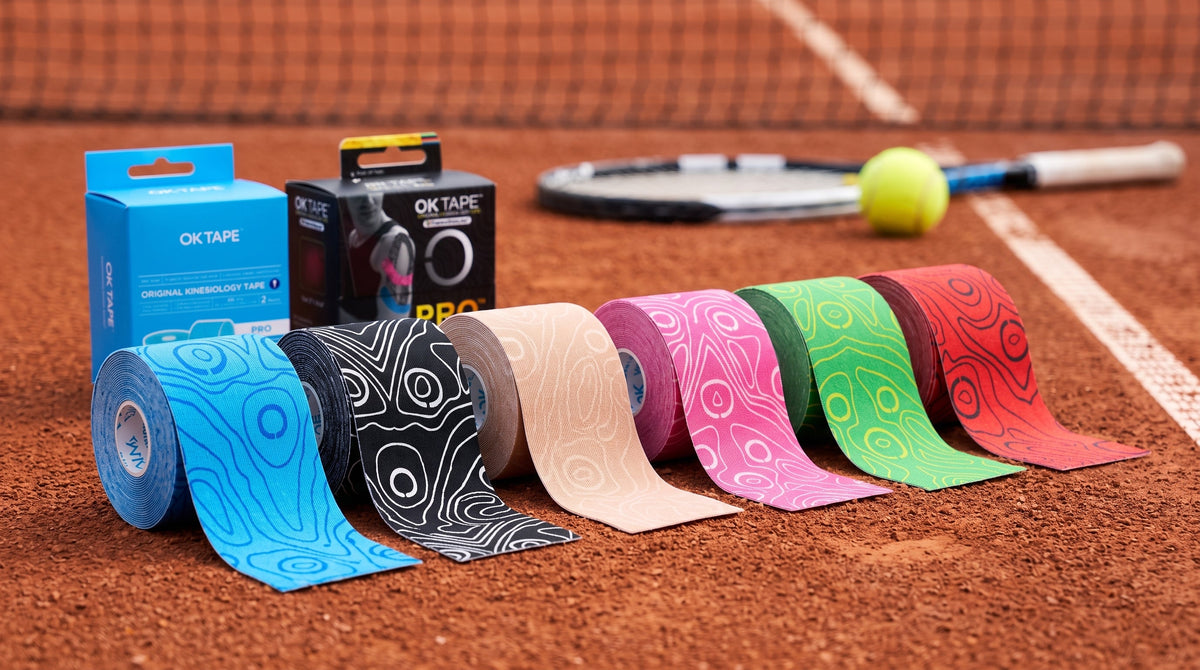
Whether on the ATP and WTA tours or at a league match at your club: kinesiology tape has long been a familiar sight in modern tennis. One thing stands out at once: the elastic strips come in all kinds of bright colours, from blue to red to black. But is the choice of colour purely about looks, or do the colours have a specific function?
Same material, different effect in the mind
In purely physical terms, there is reassurance for anyone who fears a medical difference: all versions of the OK TAPE Pro kinesiology tape are made of exactly the same high-quality components. The backing material is 93% cotton and 7% elastane and is coated with a breathable, wave-patterned acrylic adhesive. Elasticity and adhesive strength are identical for every colour.
In sports practice and in kinesiology colour theory (K-Taping), the colours are nevertheless said to have a specific energetic and psychological effect. Colour therapy works with visual stimuli.
The 6 colours and what they mean in tennis
1. Blue: calming and cooling
In colour therapy, blue is considered calming. The colour signals coolness and recovery.
- Typical use in tennis: On the elbow or the knee.
2. Red: activating and warming
Red stands for warmth and energy.
- Typical use in tennis: Before intense matches, for example on the back or the calf.
3. Pink: strongly stimulating
Pink is an intensified form of red. The bright colour sends strong visual signals and is used in elite sport.
- Typical use in tennis: On the shoulder before serve and overhead sessions.
4. Black: powerful
In kinesiology, black is associated with power, firmness and dominance. Many tournament players choose black tape for mental reasons, to feel focused and resilient.
- Typical use in tennis: Often applied as an anchor strip over coloured tapes or on the ankle.
5. Green: balancing
Green is the classic colour of balance. It is neither strongly stimulating nor dampening, but supports inner balance.
- Typical use in tennis: Between two tournament days.
6. Beige: neutral and discreet
Beige (skin tone) is completely neutral in terms of colour therapy. It is ideal for athletes who prefer a discreet tape.
- Typical use in tennis: Competitions with strict dress codes, everyday situations at work or when the tape should stay invisible under sportswear.
4 steps for the best hold on court
To make sure the OK TAPE Pro kinesiology tape stays in place even during sweaty rallies, keep the following points in mind:
- Prepare the skin: Clean the area of skin thoroughly, dry it and remove any oils. Apply the tape about 30 to 60 minutes before the match.
- Round the corners: Cut the corners of the tape round with scissors. This stops the tape catching on tennis socks or clothing.
- Apply the ends without stretch: Always lay the first and last three to five centimetres down with no tension at all. Only the middle section is stretched.
- Remove gently: Peel the tape off carefully in the direction of hair growth, ideally in the shower or with a little baby oil.
Which colour you choose in the end depends on your individual needs: go for cool tones, bold colours or simply the version that gives you the most confidence on court. If you are in pain, seek advice from a doctor or physiotherapist.