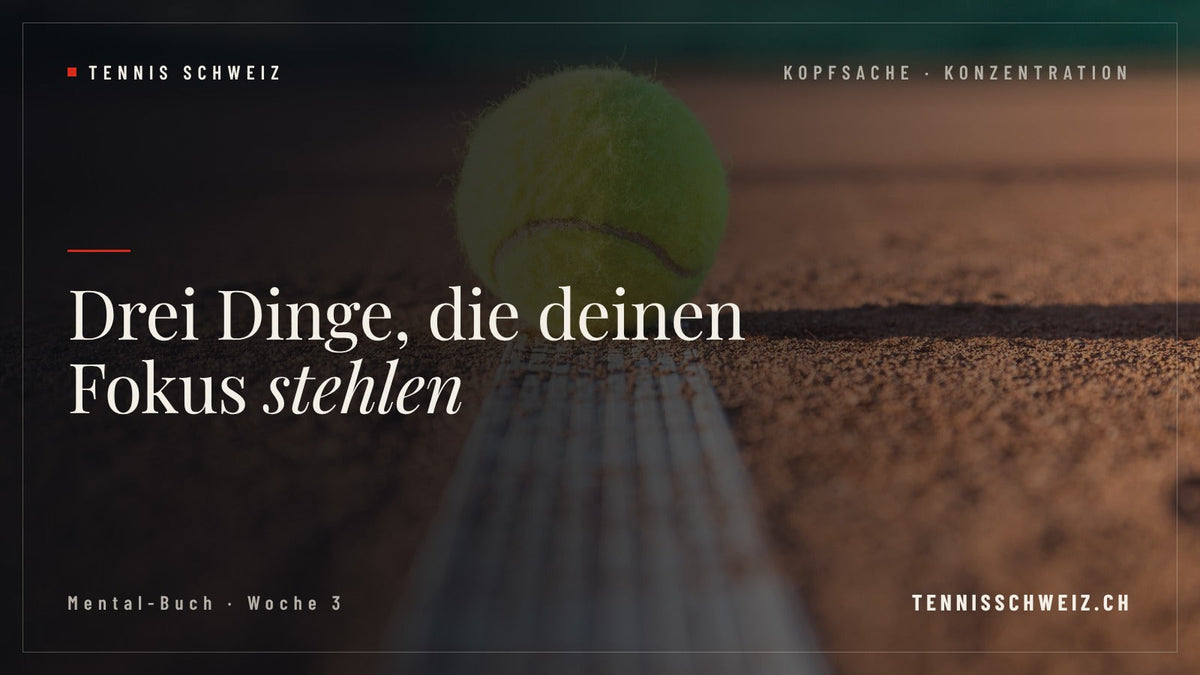
You are standing on court, but part of you is still at the office. Another part is stuck on the double fault from earlier. And a third is already working out how many games are still needed. Little attention is left for the ball.
Three distractions cost points particularly often in tennis. If you know them, you find your way back faster.
1. The score
“Two more games and I have won.” With this thought you are in the future. A deliberate step back into your routine helps: look wide, plan for the next point, focus word, ball. The post Keep your focus in the tiebreak explains how that works in tight moments.
2. The last mistake
If you think only about the mishit ball between points, you miss what is happening on the other side. Open the spotlight again after every point: where is your opponent standing, what will you play next? The post Focus switch: wide, word, ball explains the four settings of your focus.
3. Your mind is still elsewhere
The researcher Sophie Leroy described in 2009 that when you switch between two tasks, part of your attention stays stuck on the first. She called this attention residue. So finish one thing or deliberately park it before you go on court. Your phone can stay in your bag during this time.
Then there are things you cannot change, such as wind or noise from the next court. The post Circle of control: play the ball, not the wind shows how to deal with them.
Challenge of the week: ten minutes of bounce-hit
- During the warm-up, quietly say “Bounce” as soon as the ball bounces.
- Say “Hit” as soon as someone hits it, you or your opponent.
- Stay with it for at least ten minutes.
- Count how many rallies in a row you manage without missing a word. That is your record.
Frequently asked questions about distractions in tennis
Is it bad if my thoughts drift off?
No. Drifting off is the normal state. What matters is how quickly you find your way back to the ball.
Which distraction costs the most points?
That is different for every person. After a match, note where your thoughts wandered. That way you spot your pattern.
Does this help off the court too?
Yes. Doing one thing after another also helps with studying and at work.
How to practise it with the Mental Journal
In the focus week of the Mental Journal by Tennis Schweiz you find out which distractions cost you the most points. You try bounce-hit, look for your focus word and carry the focus over into school, work and everyday life. At the end of the week you look back at your notes.
You will find more mental tips under All Kopfsache posts.